
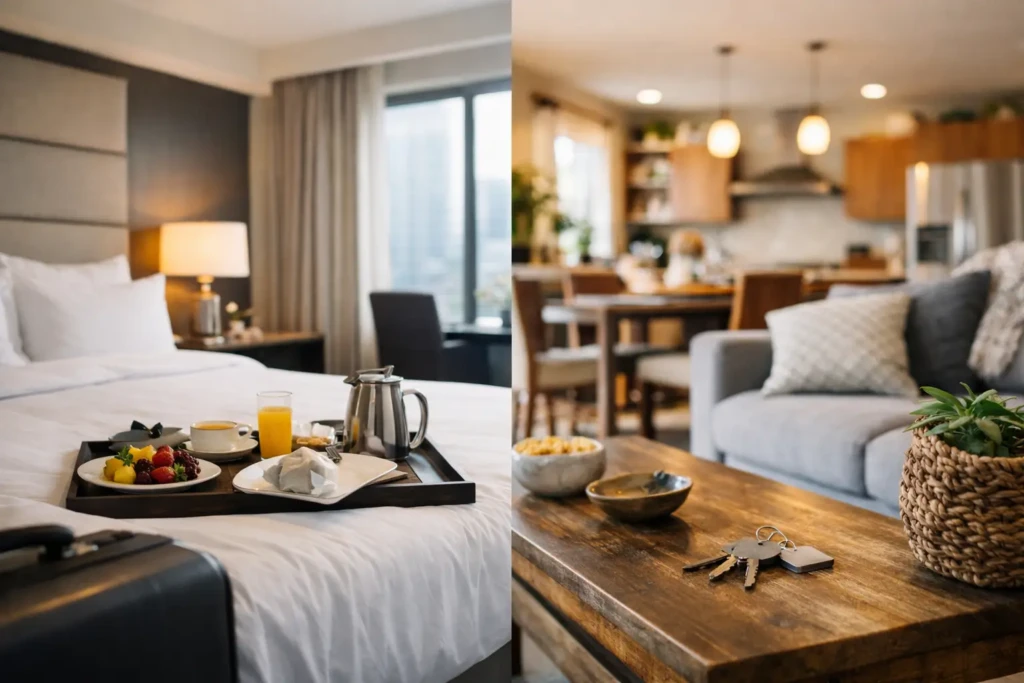
A two-week work assignment can make a standard hotel room feel small quickly. Add video calls, irregular hospital shifts, children between school transitions, or the need to cook more than takeout, and the decision becomes about more than a nightly rate. When comparing a hotel versus furnished home stay, the better option is the one that supports how you need to live, work, and recharge while you are in Central Florida.
Hotels remain a practical choice for short visits and uncomplicated schedules. A furnished home stay is often the stronger fit when your trip lasts several weeks, involves colleagues or family, or requires a dependable place to handle everyday life. The key is understanding where each option delivers the most value.
Hotel versus furnished home stay: the real difference
A hotel is designed for temporary convenience. You check in, sleep, use a compact workspace if one is available, and rely on the property or nearby restaurants for most daily needs. For a one- or two-night meeting, that simplicity may be exactly right.
A furnished home stay is designed to feel operational from the moment you arrive. Instead of adapting your routine to a single room, you have separate areas for sleeping, working, preparing meals, and spending time together. For business travelers, travel nurses, relocating employees, and families in transition, that distinction can affect productivity, privacy, and the overall cost of a longer stay.
The choice is not simply hotel luxury versus home comfort. It is a question of whether you need a place to visit or a place to function.
When a hotel is the better choice
Hotels work well when your stay is brief, your schedule keeps you out most of the day, and you are traveling alone. A central front desk, daily housekeeping, on-site dining, and fast check-in can remove friction when time is limited.
They can also be useful when plans are uncertain. If an assignment may end after a few nights or a meeting schedule could change at the last minute, booking a hotel can feel less complicated than arranging a longer housing commitment.
For solo travelers on a short business trip, a hotel can provide a predictable experience with minimal planning. There is no grocery run, no need to decide how to divide bedrooms, and no expectation that you will settle into a routine. That convenience has real value.
Still, the room rate is only one part of the calculation. Restaurant meals, laundry charges, parking, and the lack of a kitchen can make a hotel stay less appealing as days turn into weeks.
Where a furnished home stay changes the experience
For extended travel, space becomes a practical business need rather than a luxury. A fully furnished home gives each guest room to work, rest, and maintain normal routines without turning one hotel room into an office, dining room, and bedroom all at once.
A well-appointed home can include dedicated workspaces, high-speed Wi-Fi, multiple bedrooms and bathrooms, a full kitchen, comfortable living areas, and in-home laundry. Those features are especially meaningful for professionals who need to join confidential calls, travel nurses working rotating schedules, or families balancing work with school and childcare.
A kitchen is often one of the biggest advantages. It gives guests more control over meals, dietary needs, and spending. After a 12-hour shift or a full day of client meetings, being able to prepare a familiar meal can feel far more restorative than another restaurant order.
Privacy matters, too. In a home with separate bedrooms and shared gathering areas, a corporate team can spend time together without being confined to a lobby or separate rooms across a hotel floor. A relocating family can give children their own space while adults manage paperwork, home searches, and work responsibilities.
Compare the total stay cost, not just the nightly rate
The most useful hotel versus furnished home stay comparison starts with the full cost of living during the trip. A hotel may show a lower nightly rate at first glance, but the total can rise once you include dining, laundry, parking, extra rooms for colleagues or family members, and other daily expenses.
A furnished home stay often consolidates what travelers would otherwise arrange separately: furniture, kitchen equipment, utilities, Wi-Fi, laundry access, and living space. For a team or family, one multi-bedroom home may also be more efficient than reserving several hotel rooms.
That does not mean a furnished home is automatically less expensive. Premium homes with specialized amenities or peak-season demand can carry higher rates. However, the value equation usually improves as the stay gets longer and the number of occupants increases. Ask for a clear quote that identifies what is included, the stay length, cleaning expectations, deposits if applicable, and any pet-related terms.
Direct booking can also reduce some third-party platform fees. For corporate stays or a 90-plus-night housing need, requesting a custom quote can be a smarter first step than trying to make a standard nightly listing fit a more complex assignment.
Productivity needs should guide business travel housing
Business travel housing should support the work, not create more of it. Before booking, consider whether the property gives you a real place to focus. A small desk in a busy hotel room may be enough for email, but it may not be ideal for extended calls, project deadlines, or work that requires privacy.
For remote or hybrid professionals, reliable high-speed Wi-Fi and an intentional workspace are essential. So is a layout that allows one person to work while another rests or joins a separate call. Teams should also consider proximity to job sites, meeting locations, hospitals, and major roadways around Davenport and Kissimmee.
Travel nurses have a particularly specific set of needs. Shift work can make quiet sleep during daytime hours crucial, while a kitchen, laundry, and comfortable recovery space help make demanding assignments more manageable. A furnished home stay offers a more stable base between shifts than a room built primarily for overnight guests.
What relocating families need most
During a move, temporary housing should reduce uncertainty rather than add to it. Families may be waiting for a closing date, completing repairs, exploring neighborhoods, or coordinating school enrollment. They need space for everyone, not just a place to sleep.
Multiple bedrooms and bathrooms can preserve routines during a disruptive season. A living room gives the family a place to reconnect, while outdoor areas and entertainment spaces can make downtime easier for children. A full kitchen also helps families maintain familiar meals and schedules when much of life is in motion.
Location should be weighed carefully. The closest property is not always the best property if it lacks the layout, parking, safety features, or amenities your family needs. The right temporary home should make the transition feel more manageable from day one.
Service is the deciding factor many guests overlook
The gap between a hotel and a furnished home stay is not always about square footage. It is often about the level of support behind the stay. Hotels have established service systems, while peer-to-peer rentals can vary widely in responsiveness, accuracy, and readiness.
For a longer stay, choose a provider that communicates clearly before arrival and remains available if you need assistance. Confirm the check-in process, support contact, Wi-Fi details, parking instructions, maintenance response expectations, and whether transportation coordination or local experience planning is available.
Florida HomeShares combines the room and privacy of a furnished home with a service-first approach built for guests who cannot afford unnecessary disruptions. That includes amenity-rich homes suited to corporate assignments, travel nursing contracts, team relocations, and family transitions in Central Florida.
A simple way to make the right choice
Choose a hotel when you need a short, solo, low-planning stay. Choose a furnished home stay when you need more than a room: separate spaces, a kitchen, reliable work features, room for a family or team, and the ability to settle into a routine.
Before you book, picture an ordinary weekday during your trip. Where will you take calls? Where will you prepare dinner after a long shift? Can your family relax while you work? Will everyone have privacy? The answers usually point to the accommodation that will make your time in Central Florida feel supported, productive, and genuinely comfortable.
 ZH
ZH  EN
EN  ES
ES  PT
PT  ZH_HK
ZH_HK  FR
FR 