
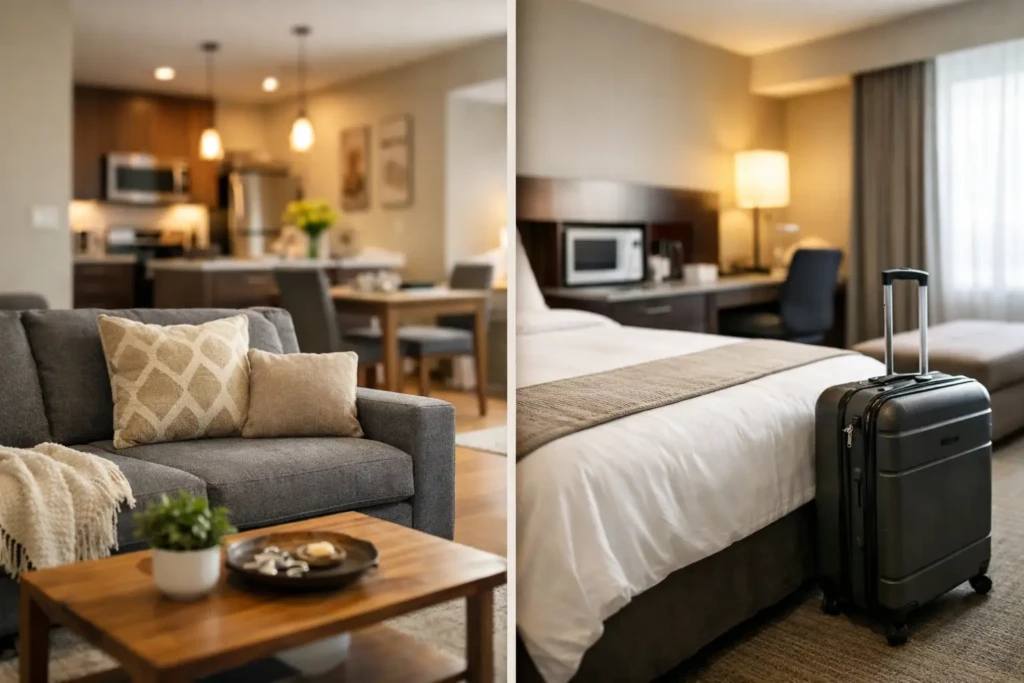
You can feel the difference by day three. In a hotel-style extended stay, you are still living out of bags, eating around a small kitchenette, and taking calls from a chair that was never meant to be your office. In a furnished rental, the stay starts to feel less temporary. That is the real question behind furnished rental vs extended stay – not just where you sleep, but how well the space supports your work, routine, and peace of mind.
For business travelers, travel nurses, relocating families, and project-based teams, the right choice depends on more than nightly rate. It comes down to how long you are staying, how much space you need, and how much support you expect once you arrive. Both options solve a short-term housing problem. They just solve different versions of it.
Furnished rental vs extended stay at a glance
An extended stay is usually a hotel product designed for guests who need more than a few nights and less than a traditional lease. You typically get a private room or studio, a compact kitchen, weekly housekeeping, and front-desk style operations. It is familiar, standardized, and often convenient when you need something fast.
A furnished rental is closer to a fully functional home. It usually includes separate living areas, full kitchens, multiple bedrooms in many cases, in-unit laundry, dedicated workspaces, and a layout designed for actual daily living. The best furnished rentals also add managed hospitality support, which matters when your stay is tied to work, a move, or a family transition.
If your priority is basic accommodation with hotel infrastructure, extended stay can work. If your priority is livability, privacy, and a more residential experience, a furnished rental usually has the advantage.
Where cost really shifts
On paper, extended stay properties can look straightforward. You see a nightly rate, you know what is included, and booking feels simple. But longer stays can expose the limits of that pricing model, especially if you need more than one room, need parking, or end up spending more on takeout because the cooking setup is minimal.
A furnished rental often delivers better value over several weeks or months because the space is built for regular life. A full kitchen reduces meal costs. Laundry in the home cuts out time and extra spending. If you are traveling with a spouse, children, or a colleague, one home may cost less than booking multiple hotel rooms while giving everyone more room to breathe.
That said, it depends on the length and purpose of the stay. For a solo traveler on a short assignment, an extended stay may be financially practical. For a 30-, 60-, or 90-night stay, especially with family or a team, a furnished rental often becomes the more efficient option.
Space changes the experience
This is where furnished rental vs extended stay becomes less abstract and more personal. Space affects sleep, productivity, and stress.
Extended stay hotels are built for compact living. That can be enough if your days are spent mostly off-site and you only need a clean place to return to at night. But when your room also has to function as your office, kitchen, dining area, and downtime space, the layout starts working against you.
A furnished rental gives each part of the day its own place. You can take meetings without sitting on the edge of a bed. You can cook dinner without clearing your laptop first. You can close a bedroom door and create separation between work and rest. For relocating families, that extra space is not a luxury. It is what keeps temporary housing from feeling chaotic.
For travel nurses working long shifts, the difference can be even more practical. Quiet matters. A real kitchen matters. Laundry matters. Coming back to a home-like setting instead of a hotel corridor can make recovery easier during demanding assignments.
Service is not the same in every model
Many travelers assume extended stay means better service because it operates like a hotel. Sometimes that is true. There is usually a front desk, standardized procedures, and predictable check-in. But predictability is not always the same as personalized support.
A professionally managed furnished rental can offer a more attentive experience, particularly when the provider is set up for corporate housing and transitional stays rather than casual vacation traffic. That means responsive communication, move-in clarity, arrival coordination, reliable Wi-Fi, and help that extends beyond handing over a key code.
This distinction matters if your schedule is tight or your housing need is tied to something stressful, like a relocation, temporary job placement, or insurance-related displacement. You do not just need a place to sleep. You need a stay that works the first time.
That is where premium operators stand apart. Florida HomeShares, for example, positions the stay as a supported experience, not just a reservation, which is especially valuable for guests balancing work demands, family logistics, or an unfamiliar area.
Flexibility and length of stay
Extended stay hotels are often easiest for short notice bookings and shorter commitments. If you need a quick solution for one to two weeks, they can be a practical answer. They are also familiar to corporate travel departments that already use hotel booking systems.
Furnished rentals tend to shine when the timeline is less tidy. Maybe a home closing gets delayed. Maybe a hospital contract extends. Maybe a project team needs 90 days now but might need longer. In those cases, flexible furnished housing is usually better aligned with real life.
The key is to ask what kind of flexibility you actually need. Do you want the freedom to extend without moving? Do you need enough room for a family to settle in? Do you want to avoid setting up utilities, furniture, and internet for a stay that is temporary but not brief? Those are furnished rental questions, and they matter more the longer the stay becomes.
Privacy, routine, and quality of life
People often focus on square footage and forget about routine. But routine is what makes a temporary stay manageable.
Extended stay hotels can start to feel repetitive. Shared hallways, limited common areas, and the constant sense of being in a commercial environment can wear on guests over time. That is not a problem for everyone, but it is a real trade-off.
A furnished rental supports normal habits more naturally. You can grocery shop once and actually store what you buy. You can spread out. You can host a visiting family member for dinner. You can keep your schedule without feeling like every part of your day is compressed into one room.
For corporate travelers, that often means better focus. For families, it means fewer frictions. For anyone in transition, it means the temporary stop feels more stable.
Which option fits which traveler?
If you are a solo business traveler on a brief assignment, an extended stay can be the faster and simpler choice. If you value daily hotel access points more than square footage, it may check enough boxes.
If you are staying longer, working remotely part of the time, traveling with a partner, bringing children, or relocating between homes, a furnished rental is usually the better fit. The same applies to travel nurses, project teams, and professionals who need a real setup for both work and recovery.
The middle ground is where people get stuck. A two-week stay can go either way. So can a month-long trip. In those cases, ask yourself a better question than which one is cheaper. Ask which one reduces friction. The answer usually points to the better value.
How to choose without regretting it
Before booking, look past the marketing terms. Some places call themselves extended stay but function like standard hotels with a microwave. Some furnished rentals look good in photos but lack the consistency and support business travelers actually need.
Focus on the fundamentals. Is there a full kitchen or just a basic setup? Is there dedicated workspace with strong Wi-Fi? Is laundry in the unit? Is support responsive and clear? If the stay is for more than a couple of weeks, can you honestly picture living there, not just sleeping there?
That last question matters most. Temporary housing works best when it asks less of you. The right stay should help you settle in quickly, stay productive, and feel taken care of without chasing down details.
If you are weighing furnished rental vs extended stay, the better choice is usually the one that gives you enough room to live well while everything else is in motion. When your trip is tied to work, recovery, or transition, comfort is not extra. It is part of what makes the stay successful.
 EN
EN  ES
ES  PT
PT  ZH
ZH  ZH_HK
ZH_HK  FR
FR 