
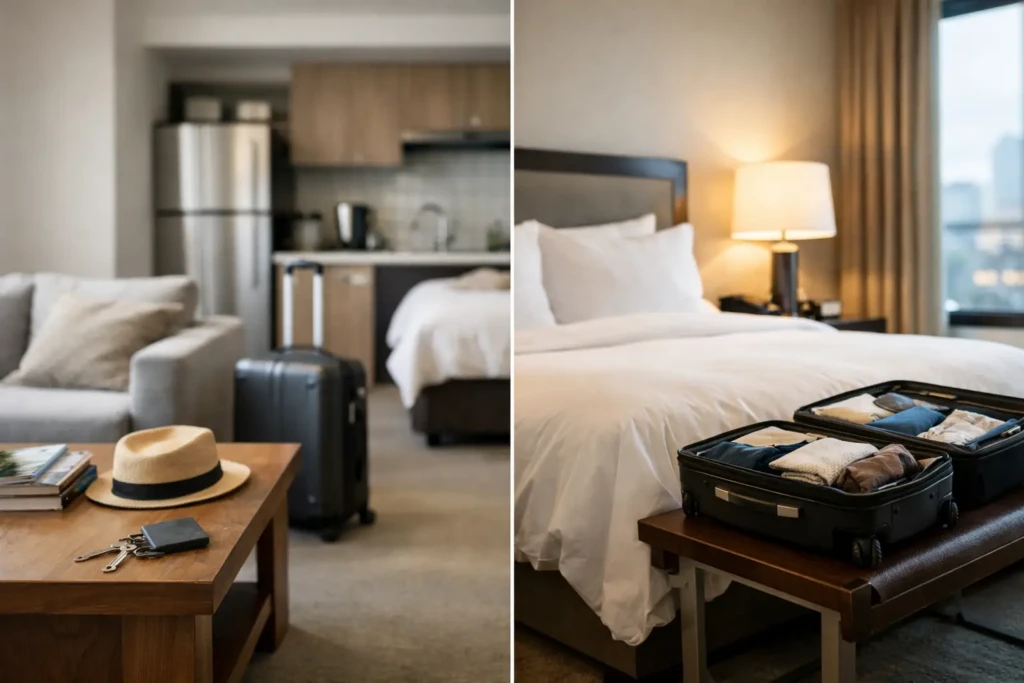
A 30-night booking can look simple on paper until real life shows up. You need a quiet place for calls, a kitchen that works, enough room to unpack, and support that does not disappear after check-in. That is where the monthly stay versus extended hotel decision stops being about nightly rates and starts being about how well your housing actually supports your work and routine.
For business travelers, travel nurses, relocating professionals, and families between homes, the right answer depends on more than price. It depends on how much space you need, how long you are staying, whether you are traveling alone or with others, and how much day-to-day friction you are willing to tolerate.
Monthly stay versus extended hotel: what is the real difference?
An extended hotel is built around hotel operations. You usually get a private room or studio, a compact kitchenette, weekly or limited housekeeping, and standard front-desk support. It is familiar, and for short stretches that simplicity can work well.
A monthly stay in a furnished home is built around living, not just sleeping. Instead of fitting your life into one room, you get separate spaces for working, cooking, relaxing, and sleeping. In the best setups, utilities, Wi-Fi, furnishings, and household essentials are already handled, so you still get the turnkey convenience people want from a hotel, but with far more breathing room.
That difference matters quickly. By week two or three, a hotel room often starts to feel smaller than it looked online. Meals become repetitive, laundry turns into a chore, and it gets harder to separate work time from downtime. A furnished monthly stay tends to hold up better because it functions like a real residence.
When an extended hotel makes sense
There are cases where an extended hotel is the better fit. If you are traveling solo for a shorter assignment, expect to be out most of the day, and do not care much about entertaining, cooking, or spreading out, the simplicity can be appealing. Hotels also work well for travelers who want a standardized setup with predictable check-in procedures and minimal decision-making.
For a one- or two-week stay, the trade-off may be perfectly reasonable. You may not need a full living room, multiple bedrooms, or outdoor space. If your schedule is packed and you just need a clean place to sleep, shower, and answer a few emails, an extended hotel can cover the basics.
The issue is that many guests book a hotel for a month assuming the experience will scale smoothly. Often it does not. What feels efficient for a few nights can feel restrictive across 30, 60, or 90 days.
Where a monthly stay often delivers more value
If you are on a travel nursing assignment, supporting a team relocation, managing a project in Central Florida, or waiting on a home closing, a monthly stay usually aligns better with how you actually live. The value is not only square footage. It is the ability to have a routine.
A full kitchen changes your budget and your schedule. Dedicated workspaces change your productivity. Multiple bedrooms and bathrooms change the experience for colleagues, couples, and families sharing the property. Private living areas make evenings feel like personal time instead of just more time in the same room.
That is especially relevant for professionals who need to perform consistently. Good Wi-Fi is not enough if you are taking meetings from the edge of a bed. A place can be furnished and still not be functional. The better monthly stay options are designed with work and comfort in mind, not just occupancy.
Cost is not as simple as the nightly rate
This is where people often make the wrong comparison. An extended hotel may appear cheaper at first glance because the advertised nightly rate is easy to understand. But a longer stay has hidden lifestyle costs.
Eating out more often adds up fast. Paying for extra laundry services adds up. Booking additional rooms for family or coworkers adds up even faster. So does the productivity cost of trying to work in a cramped environment or the personal cost of having no real separation between your workday and your rest.
A monthly stay in a furnished home can look like a larger commitment, yet the overall value may be better once you account for kitchen use, shared occupancy, included amenities, parking, in-home laundry, and the ability to live normally. For corporate teams and families, one well-appointed home can be far more economical than multiple hotel rooms.
The right question is not Which one has the lower posted rate? It is Which one gives me the better total living experience for the money?
Privacy, quiet, and control
Extended hotels are designed for turnover. People check in late, leave early, gather in common areas, and move through hallways at all hours. That energy is not always a problem, but it can wear on guests staying for several weeks.
A monthly stay generally offers more privacy and a stronger sense of control over your environment. You are not working beside the bed where you sleep. You are not sharing walls with a constant cycle of short-term guests to the same extent. You can cook, host a quiet dinner, keep your schedule, and settle into a routine that feels stable.
For travel nurses coming off long shifts, for executives balancing remote work with local meetings, and for families trying to keep children on a normal schedule, that quiet stability has real value.
Service still matters – and it should not disappear outside a hotel
One reason some travelers hesitate to book a monthly stay is the fear of giving up support. That concern is fair. Not every furnished rental delivers consistent service, and not every host operates like a hospitality professional.
This is where the quality of the provider matters as much as the property itself. A premium monthly stay should not feel like you are on your own. It should feel supported from booking through departure, with responsive communication, clear standards, and help when plans shift.
That is why professionally managed corporate housing stands apart from casual peer-to-peer rentals. You keep the advantages of residential space without sacrificing reliability. Florida HomeShares, for example, is built around that balance – furnished homes designed for productive extended stays, paired with concierge-style support that reduces the usual friction of temporary housing.
Who should choose which option?
If you are a solo traveler on a brief assignment and convenience matters more than space, an extended hotel can be a reasonable choice. If your stay may stretch beyond a couple of weeks, or you know you will need to cook, work privately, or live with a partner, child, or teammate, a monthly stay usually becomes the stronger option.
Travel nurses often benefit from the calm and practicality of a furnished home, especially during 8- to 13-week contracts. Corporate teams tend to benefit from shared space, multiple bedrooms, and a more comfortable base of operations. Relocating families almost always benefit from having room to breathe, store belongings, prepare meals, and maintain some normalcy during a disruptive season.
There is no universal winner. There is only the better fit for the way you need to live during your stay.
How to decide without overthinking it
Start with four questions. How many people are staying? How many meals will you want to make at home? How often will you need a true workspace? And how stressful will it feel to live out of one room for a month or longer?
If your honest answer points toward more space, more privacy, and a more residential routine, trust that. Temporary housing should make your life easier, not ask you to shrink your expectations for comfort and function.
A good monthly stay does more than house you. It supports the way you work, rest, and move through a demanding season. When that is the goal, the best choice is usually the one that feels less like a stopover and more like a place you can actually live well.
 EN
EN  ES
ES  PT
PT  ZH
ZH  ZH_HK
ZH_HK  FR
FR 